Right. Imagine a capsule-toy machine that distributes little books. They'd be short and small, printed cheaply to cut down on costs (because who wants to pay upwards of 50¢ for anything that comes out of a toy machine?). There is potential for a huge variety of stories to print, which would expand the consumer's reading horizons. Oscar Wilde, Jonathan Swift, Snorri Sturluson, or...dag, I can't think of anyone right now. Pretend there's a much longer, more varied list in the previous sentence.
So, let's imagine that you get a book. We'll name it something completely at random: Schmuthering Schmeights by Schmemily Schmrontë. Now, let's imagine that you don't like the book. What do you do? You buy another book, hopefully one that's not a total piece of crap! After all, it's only another 50¢.
Showing posts with label ideas. Show all posts
Showing posts with label ideas. Show all posts
Monday, May 21, 2007
Monday, May 14, 2007
Another brilliant idea
First there was "punk." Then there was "cyberpunk." Then came "steampunk." After that came a bazillion other "-punk" genres, none of which have more than a handful of stories or what-have-you, and few of which have anything to do with punk at all (but that's okay). What differentiates the "-punks" are the settings: location, time period, and people involved. Dieselpunk takes place in the 40s, peatpunk chronicles the anachronistic adventures of Vikings, transistorpunk probably has something to do with radios...there's one called heliumpunk too, but I have no idea what that's about....
See? It gets confusing quickly. No one can remember all the "-punks," especially when many of them are just ideas that have no literary base for themselves. We need a place to catalogue all of them!
Enter Anachronismopedia. It's a single huge image map, a timeline that covers 8000 years of human existence. Every "-punk" is marked by when it begins and ends, and one can click the name of the "-punk" to be taken to a page that describes that genre in more detail. I've already started working on this, so no one steal it!
See? It gets confusing quickly. No one can remember all the "-punks," especially when many of them are just ideas that have no literary base for themselves. We need a place to catalogue all of them!
Enter Anachronismopedia. It's a single huge image map, a timeline that covers 8000 years of human existence. Every "-punk" is marked by when it begins and ends, and one can click the name of the "-punk" to be taken to a page that describes that genre in more detail. I've already started working on this, so no one steal it!

Friday, May 11, 2007
Viva...breadfruit?
I am jonesing for some breadfruit. This is a dilemma, because breadfruit quite literally does not exist at this latitude (a fact you may recall from a prior post, Viva Potato). There are many factors standing in the way of me getting fresh breadfruit in the comfort of my own home: climate, productivity, resource efficiency, economic soundness, and public awareness.
CLIMATE: Man, I wish I wasn't an uninformed pleb when it came to horticulture. Given enough time, horticulturists could solve the issue of temperature tolerance lickity-split. The Incas did it with potatoes, which formerly only lived in the chilly chilly Andes and can now tolerate warm, humid climes. Why can't we do the same with breadfruit, except backwards? It would probably take significantly longer than it did with potatoes, because breadfruit trees take more than a few growing seasons to come to maturity. However, this is only more motivation to get started right now!
PRODUCTIVITY: This is another horticultural problelm. Breadfruit trees produce fruit year-round, but there is one major growing season in which they yield far, far more produce. I dunno. There has to be some way to change the seasonality of the plants to make them produce lots of fruit year-round. An alternative route would be to buy breadfruit from the other hemisphere; that's how we manage to get succulent plums, cherries, and other super-seasonal fruits all year.
RESOURCE EFFICIENCY: How much water and soil will the breadfruit trees require? Most likely they will demand far more of each resource (compared to yield) than other produce trees, like orange trees or cherry trees. Of course, part of this is because breadfruits are so much larger than oranges or cherries, and the tree only produces a few at a time instead of dozens.
ECONOMIC SOUNDNESS: Will financiers rush towards this venture or will they balk at the risks? I have no idea; ask them, not me. Next topic!
PUBLIC AWARENESS: No matter how much I say, most of you are probably still wondering what the hell a breadfruit actually is. This is a problem. If I could somehow inform the world of the greatness of the breadfruit tree, then it would surely gain popularity and make this a worthwhile venture that will bring joy to people worldwide!
Holy crap, I can't believe I used the phrase "lickity-split." That's seriously weird.
CLIMATE: Man, I wish I wasn't an uninformed pleb when it came to horticulture. Given enough time, horticulturists could solve the issue of temperature tolerance lickity-split. The Incas did it with potatoes, which formerly only lived in the chilly chilly Andes and can now tolerate warm, humid climes. Why can't we do the same with breadfruit, except backwards? It would probably take significantly longer than it did with potatoes, because breadfruit trees take more than a few growing seasons to come to maturity. However, this is only more motivation to get started right now!
PRODUCTIVITY: This is another horticultural problelm. Breadfruit trees produce fruit year-round, but there is one major growing season in which they yield far, far more produce. I dunno. There has to be some way to change the seasonality of the plants to make them produce lots of fruit year-round. An alternative route would be to buy breadfruit from the other hemisphere; that's how we manage to get succulent plums, cherries, and other super-seasonal fruits all year.
RESOURCE EFFICIENCY: How much water and soil will the breadfruit trees require? Most likely they will demand far more of each resource (compared to yield) than other produce trees, like orange trees or cherry trees. Of course, part of this is because breadfruits are so much larger than oranges or cherries, and the tree only produces a few at a time instead of dozens.
ECONOMIC SOUNDNESS: Will financiers rush towards this venture or will they balk at the risks? I have no idea; ask them, not me. Next topic!
PUBLIC AWARENESS: No matter how much I say, most of you are probably still wondering what the hell a breadfruit actually is. This is a problem. If I could somehow inform the world of the greatness of the breadfruit tree, then it would surely gain popularity and make this a worthwhile venture that will bring joy to people worldwide!
Holy crap, I can't believe I used the phrase "lickity-split." That's seriously weird.
Wednesday, May 9, 2007
Another Brilliant Idea
I'm going to invent a new kind of breakfast ceral. All the pieces are shaped like noses. I shall call it Cereal de Bergerac.

I know I've mentioned this to a lot of people, so it's kind of a cop-out, but I've an excuse! This was written on the 24th, but I got distracted by the ULWPP.
I know I've mentioned this to a lot of people, so it's kind of a cop-out, but I've an excuse! This was written on the 24th, but I got distracted by the ULWPP.
Monday, May 7, 2007
Borrowing a page from Bislama
(I told this idea to about a dozen people already today, but I think it's so great that I need to share it even more.)
In the English language, questions with negative modifiers are terribly open-ended. A straightforward question is "Have you heard the news?" This question can be answered in two ways with two distinct meanings:
"Yes, your statement is true and I have heard the news"
"No, your statement is false and I have not heard the news."
However, if one adds a negative modifier, making the question "Haven't you heard the news?" there are suddenly four ways to answer:
"Yes, your statement is true and I have not heard the news."
"No, your statement is false and I have heard the news."
"Yes, I have heard the news. Your statment is false."
"No, I have not heard the news. Your statement is true."
This generates confusion and inevitably requires some level of clarification. This question-response process needs streamlining, and Bislama knows how to do it!
Bislama, as you may recall, was created by people who though English was nutty enough as it was already, and created a rather minimalist language that simplified many of English's intricacies. One of the ways they did this was by changing how people respond to questions. A standard question, like in English, can be answered in two ways: Yes and no. However, to eliminate the ambiguity of English questions with negative modifiers, one would instead answer with si or no. Personally, I'd change no to something else, like na or ni, but the first one might still be confusing and the other is actually used as a weapon by some knights.
Anyway, "si" is used to mean "Yes, I have done the action asked and your statement is false," while "no" means "No, I have not done the action asked and your statement is true." If we adopt these practices today, we can end ambiguity tomorrow! Or maybe the day after tomorrow! Or some time after that!
In the English language, questions with negative modifiers are terribly open-ended. A straightforward question is "Have you heard the news?" This question can be answered in two ways with two distinct meanings:
"Yes, your statement is true and I have heard the news"
"No, your statement is false and I have not heard the news."
However, if one adds a negative modifier, making the question "Haven't you heard the news?" there are suddenly four ways to answer:
"Yes, your statement is true and I have not heard the news."
"No, your statement is false and I have heard the news."
"Yes, I have heard the news. Your statment is false."
"No, I have not heard the news. Your statement is true."
This generates confusion and inevitably requires some level of clarification. This question-response process needs streamlining, and Bislama knows how to do it!
Bislama, as you may recall, was created by people who though English was nutty enough as it was already, and created a rather minimalist language that simplified many of English's intricacies. One of the ways they did this was by changing how people respond to questions. A standard question, like in English, can be answered in two ways: Yes and no. However, to eliminate the ambiguity of English questions with negative modifiers, one would instead answer with si or no. Personally, I'd change no to something else, like na or ni, but the first one might still be confusing and the other is actually used as a weapon by some knights.
Anyway, "si" is used to mean "Yes, I have done the action asked and your statement is false," while "no" means "No, I have not done the action asked and your statement is true." If we adopt these practices today, we can end ambiguity tomorrow! Or maybe the day after tomorrow! Or some time after that!
Monday, April 30, 2007
Chat tax!
I think constantly being on IRC is destroying my vocabulary. I find myself more and more often struggling to find words that eloquently convey my messages. I have come up with a most logical solution to this problem: ChatTax.
ChatTax is a program that forces the user to read passages of well-worded, vivid, enjoyable prose for 15 minutes or so before allowing the user onto his chat program of choice. It also has access to an electronic dictionary so the user can look up unfamiliar words without the effort of pulling out a meatspace dictionary.
I'm serious about this. It's a brilliant idea that could possibly make me millions while simultaniously alienating entire legions of teenagers whose parents bought my program!
Unfortunately, I can't code. Does anyone out there want to develop ChatTax and split the proceeds 50-50?
ChatTax is a program that forces the user to read passages of well-worded, vivid, enjoyable prose for 15 minutes or so before allowing the user onto his chat program of choice. It also has access to an electronic dictionary so the user can look up unfamiliar words without the effort of pulling out a meatspace dictionary.
I'm serious about this. It's a brilliant idea that could possibly make me millions while simultaniously alienating entire legions of teenagers whose parents bought my program!
Unfortunately, I can't code. Does anyone out there want to develop ChatTax and split the proceeds 50-50?
Monday, April 9, 2007
A disappointing post!
This was going to be a post about cats and pennies and such, but it's late and I'll save that for a time when I have more energy. Right now I'm at the very beginning of a new project: a mechanical television.
Other, bolder people could turn this device into something new and amazing. I'm probably going to take the lame route and not add anything new. If I were to add something new, it would be sound. That seems remarkably easy to do, but some stuff I've read seems to imply otherwise.
Anyway, mechanical TVs work by a single light source rapidly changing brightness to represent different shades of grey. Each instance of brightness is shone through a hole in a rapidly spinning disc, so that a little square appears in on the other side of the disc in the same shade as the light source. Do this 6400 times a second and you have a mechanical TV! The best part is that the information being sent requires no film, very low voltage, and can run for hours using only a CD player.
I should get started. So long, aetherweb!
Other, bolder people could turn this device into something new and amazing. I'm probably going to take the lame route and not add anything new. If I were to add something new, it would be sound. That seems remarkably easy to do, but some stuff I've read seems to imply otherwise.
Anyway, mechanical TVs work by a single light source rapidly changing brightness to represent different shades of grey. Each instance of brightness is shone through a hole in a rapidly spinning disc, so that a little square appears in on the other side of the disc in the same shade as the light source. Do this 6400 times a second and you have a mechanical TV! The best part is that the information being sent requires no film, very low voltage, and can run for hours using only a CD player.
I should get started. So long, aetherweb!
Saturday, April 7, 2007
Bird cloning!
I'm lazy. Instead of getting a fresh post, you get my lecture that I delivered to nobody in particular in the #nerdparadise chatroom a few months back, which also happens to be a forum post I made about thirty seconds ago (Today's Saturday. Pretend this update happened on a Friday, okay?).
I'm really interested in cloning extinct birds (and, for that matter, most creatures that come from a hard-shelled egg). The geirfugl, the dodo, the Rodrigues solitaire, the passenger pigeon, the moa, the California condor (there are fifty-something left...it may not be extinct but it needs all the help it can get), and all sorts of dinosauranoids.
Anyway. There are lots of reasons why we have yet to bring back extinct bird species. There are two extremely large reasons.
The first is that this reintroduced specimen will have no parental figures and, consequently, much of its behaviour will be drastically different than the original species and it may not know how to act in certain situations that would doom the creature in the wild. This is unavoidable unless avian psychologists make some amazing breakthroughs soon.
The second reason, which is the one I understand far less, concerns the eggs themselves. As far as I know, not a single avian has been cloned, because the eggs are a pain to deal with. Every species' eggs are slightly different, and many extinct animals (like the dodo and Rodrigues solitaire) have no living relatives close enough to act as substitute-egg-donors. Then there's the issue of actually inserting the extinct animal's genetic information into the nucleus of the egg cell before it starts to form a morula. Then there's the issue of successfully implanting the egg in a suitable foster parent (because, really, there's no way in hell you're going to have any modern bird lay a dinosaur egg) who will also care for the young hatchling if need be.
The only solution I can think of for issue #2 would be to invent several new substances that can act as artificial albumen, yolk, shell, and other stuff that goes into eggs. It would have to be pliable at times, to allow for gene-insertion as well as readjusting the levels of the fluids and nutrients in the egg, but it would also have to be rigid to mimic a proper egg. I dunno. Someone else can figure that one out.
Recommended reading: Digging for Dodos by Ian Parker, New Yorker Magazine, January 22, 2007. The link I provided is not the full text; it continues for many more pages. While you're at it, you might as well read Jurassic Park and The Lost World by Michael Crichton.
I'm really interested in cloning extinct birds (and, for that matter, most creatures that come from a hard-shelled egg). The geirfugl, the dodo, the Rodrigues solitaire, the passenger pigeon, the moa, the California condor (there are fifty-something left...it may not be extinct but it needs all the help it can get), and all sorts of dinosauranoids.
Anyway. There are lots of reasons why we have yet to bring back extinct bird species. There are two extremely large reasons.
The first is that this reintroduced specimen will have no parental figures and, consequently, much of its behaviour will be drastically different than the original species and it may not know how to act in certain situations that would doom the creature in the wild. This is unavoidable unless avian psychologists make some amazing breakthroughs soon.
The second reason, which is the one I understand far less, concerns the eggs themselves. As far as I know, not a single avian has been cloned, because the eggs are a pain to deal with. Every species' eggs are slightly different, and many extinct animals (like the dodo and Rodrigues solitaire) have no living relatives close enough to act as substitute-egg-donors. Then there's the issue of actually inserting the extinct animal's genetic information into the nucleus of the egg cell before it starts to form a morula. Then there's the issue of successfully implanting the egg in a suitable foster parent (because, really, there's no way in hell you're going to have any modern bird lay a dinosaur egg) who will also care for the young hatchling if need be.
The only solution I can think of for issue #2 would be to invent several new substances that can act as artificial albumen, yolk, shell, and other stuff that goes into eggs. It would have to be pliable at times, to allow for gene-insertion as well as readjusting the levels of the fluids and nutrients in the egg, but it would also have to be rigid to mimic a proper egg. I dunno. Someone else can figure that one out.
Recommended reading: Digging for Dodos by Ian Parker, New Yorker Magazine, January 22, 2007. The link I provided is not the full text; it continues for many more pages. While you're at it, you might as well read Jurassic Park and The Lost World by Michael Crichton.
Monday, April 2, 2007
Mmmmmm...
Loaf of doughnut.
I said these words on Thursday when trying to (very inaccurately) describe brioche, a sweet French bread. Though my description failed, this statement was etched into my memory. It's heart-cloggingly awesome.
Imagine a doughnut loaf. For the most part, it would be little more than changing the shape of the doughnut. The only major altertion I can think of is that the icing/sugar/other toppings would have to be mixed in evenly because it'd be too messy to handle icing-covered bread in many situations.
Obviously, a sample must be made. I'm going to buy a whole bunch of old doughnuts from the grocery store and compress them into a dense cube. Then I will proceed to slice and enjoy my doughnut loaf. Later, I will be found dead on the floor. Maybe I died from cardiac arrest. Maybe I died from a caloric overdose. Maybe I just collapsed out of sheer ecstasy because I just ate a loaf of doughnut.
I said these words on Thursday when trying to (very inaccurately) describe brioche, a sweet French bread. Though my description failed, this statement was etched into my memory. It's heart-cloggingly awesome.
Imagine a doughnut loaf. For the most part, it would be little more than changing the shape of the doughnut. The only major altertion I can think of is that the icing/sugar/other toppings would have to be mixed in evenly because it'd be too messy to handle icing-covered bread in many situations.
Obviously, a sample must be made. I'm going to buy a whole bunch of old doughnuts from the grocery store and compress them into a dense cube. Then I will proceed to slice and enjoy my doughnut loaf. Later, I will be found dead on the floor. Maybe I died from cardiac arrest. Maybe I died from a caloric overdose. Maybe I just collapsed out of sheer ecstasy because I just ate a loaf of doughnut.
Friday, March 16, 2007
My introduction continues!
Okay, some more information.
For you people who go to school with me: no, this won't stop me from babbling madly at school. For example, you may hear me yelling about Saddam Hussein piñatas at school, then come visit my blog and see more, possibly more articulate, ranting. That's just the way it goes.
I get a lot of ideas in my sleep. I keep a little pad of paper by my bed for such occasions. Often, I wake up in the morning and see things like "BUZNESS CRAD SHREDTER" or "DID I FINNISH MATH HMEWORK?" that I had blindly scrawled at 3 a.m. before going back to bed. It's a lot of fun deciphering my horrible low-light chickenscratch.
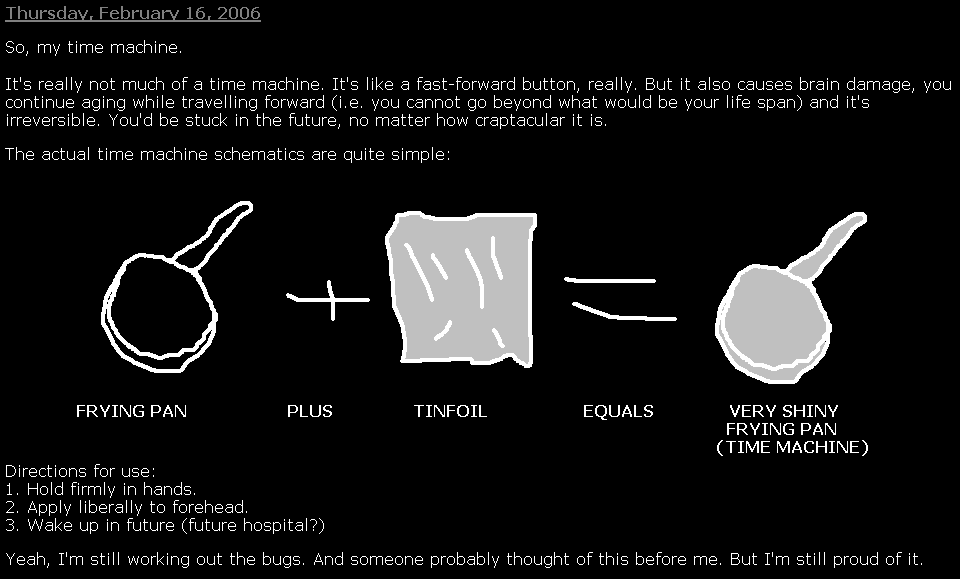
Occasionally, I will post old rants from months or years long past. Here's one from February 2006. I loves it so much.
If I think of any more things to announce, I'll make a third welcome post. Otherwise, expect real content next week or so. Byyyyyyye!
For you people who go to school with me: no, this won't stop me from babbling madly at school. For example, you may hear me yelling about Saddam Hussein piñatas at school, then come visit my blog and see more, possibly more articulate, ranting. That's just the way it goes.
I get a lot of ideas in my sleep. I keep a little pad of paper by my bed for such occasions. Often, I wake up in the morning and see things like "BUZNESS CRAD SHREDTER" or "DID I FINNISH MATH HMEWORK?" that I had blindly scrawled at 3 a.m. before going back to bed. It's a lot of fun deciphering my horrible low-light chickenscratch.
Occasionally, I will post old rants from months or years long past. Here's one from February 2006. I loves it so much.
If I think of any more things to announce, I'll make a third welcome post. Otherwise, expect real content next week or so. Byyyyyyye!
Thursday, March 15, 2007
Hi. I made a blog.
It's happened at last. I made a blog.
For the past several years, I've attempted several methods of saying "Hey! Look at me!" over the internet. I wanted a webcomic, but I can't draw. I wanted a website about webcomics, but those suck. I made a fanpage for a video game, but someone else who actually did some research beat me to the punch with a far higher-quality and in-depth page. Filmmaking, novel-writing, satirical music (actually, pretty much all of these examples were rife with satire). I couldn't decide. But one thing I didn't want was a blog. No no no. Blogs are a-dime-a-dozen, and--no offence, friends--most of the blogs I've seen are filled with nothing more than one or two sentence ramblings about how life sucks. Thanks, Sucky Blog Author. You obviously don't care about your blog, so why should I care about reading it?
Yes, I was terrified of becoming a Sucky Blog Author. I was afraid of having to be funny or insightful every single post. I was afraid of getting lazy and abandoning my minimal reader base. Actually, I'm still terrified of those things.
Sod off, Blog-Related Fears Personified. I'm not going to let you boss me around, even if you are grotesque and scary. THIS IS MY REALM OF BLOGDOM! IN YOUR FACE AFOREMENTIONED PERSONIFICATIONS OF MY FEARS!
Mmm-hm. This will hopefully end up being a conglomeration of my past aspirations. Expect many bad ideas and worse sketches, like so:

And with that, I go to bed. G'night, world!
For the past several years, I've attempted several methods of saying "Hey! Look at me!" over the internet. I wanted a webcomic, but I can't draw. I wanted a website about webcomics, but those suck. I made a fanpage for a video game, but someone else who actually did some research beat me to the punch with a far higher-quality and in-depth page. Filmmaking, novel-writing, satirical music (actually, pretty much all of these examples were rife with satire). I couldn't decide. But one thing I didn't want was a blog. No no no. Blogs are a-dime-a-dozen, and--no offence, friends--most of the blogs I've seen are filled with nothing more than one or two sentence ramblings about how life sucks. Thanks, Sucky Blog Author. You obviously don't care about your blog, so why should I care about reading it?
Yes, I was terrified of becoming a Sucky Blog Author. I was afraid of having to be funny or insightful every single post. I was afraid of getting lazy and abandoning my minimal reader base. Actually, I'm still terrified of those things.
Sod off, Blog-Related Fears Personified. I'm not going to let you boss me around, even if you are grotesque and scary. THIS IS MY REALM OF BLOGDOM! IN YOUR FACE AFOREMENTIONED PERSONIFICATIONS OF MY FEARS!
Mmm-hm. This will hopefully end up being a conglomeration of my past aspirations. Expect many bad ideas and worse sketches, like so:
And with that, I go to bed. G'night, world!
Subscribe to:
Posts (Atom)